.svg)
Introduction
Across the institutional office landscape, a distinct transaction category has gained meaningful momentum: the partial-interest transfer. These transactions include individual investors selling limited partner (LP) positions, individual lenders in a loan syndicate liquidating their positions, existing owners bringing in joint venture partners or “rescue” capital, and even fee simple owners selling their position in a ground lease in a collapsed structure to maximize value of the combined real estate. These transactions offer a targeted entry point into generational assets — often at a basis that would be difficult to replicate in an outright sale. The larger the asset, the greater the number of participant investors or lenders, and the higher the degree of complexity all correlate with the possibility of a partial-interest transaction.
Two recent Colliers-led engagements illustrate the breadth of this structure: an equity interest in Pacific Coast Towers (PCT), a 1.6 million square foot Class A campus in El Segundo, California, and a debt interest in the first-mortgage secured by 999 Third Avenue, a 985,958 square foot Class A tower in downtown Seattle. Taken together, these deals point to a broader shift in how institutional capital is accessing — and exiting — complex office positions.
Related Insight(s)

Santa Monica 2029: Entitlement Clarity, Zoning Upside, and a Reset Housing Market
Santa Monica is no longer the entitlement dead zone it once was. Backed by aggressive state housing mandates, the city has rezoned key corridors, opened up density, and created real paths to multifamily scale. This report breaks down where the growth is going, how zoning has shifted, and what it means for developers, builders, and investors looking to get ahead of the next wave of housing in one of California’s most supply-constrained coastal markets.

Signs of Stabilization: Los Angeles Office Market Mid-2025
The Greater Los Angeles office market posted mixed results in Q2 2025, with leasing activity holding steady at 7.0 million square feet year-to-date—mirroring the first half of 2024—but overall vacancy rising slightly to 24.4% Finance, legal, and healthcare tenants drove demand, while technology, media, and entertainment remained cautious in committing to long-term space strategies. Sublease availability fell to 4.2%, its lowest level in three years, signaling that much of the excess pandemic-era space has been absorbed Average asking rents increased 1.8% year-over-year to $3.92 per square foot per month, with Class A space commanding $4.22. Roughly 2.3 million square feet remain under construction, concentrated in West Los Angeles and Hollywood, with most completions expected by year-end 2026. Performance varied widely by submarket. Century City continued to lead West Los Angeles leasing, accounting for 27% of activity and achieving 5.2% annual rent growth. Downtown Los Angeles struggled with a 29.7% availability rate, while Hollywood/Mid-Wilshire reached a record 30.2% due to media consolidation. The Tri-Cities market posted modest rent gains but faced the region’s highest sublease rate at 5.2%. In contrast, San Gabriel Valley saw availability drop to 11% on strong healthcare and government demand, and the San Fernando Valley recorded leasing growth led by finance and healthcare tenants. Overall, the market shows early signs of stabilization, but recovery remains uneven. Location, building quality, and tenant mix will continue to define performance across Los Angeles office markets through the next 18 months.
Unlocking Housing Near Transit: Impacts of California Senate Bill 79
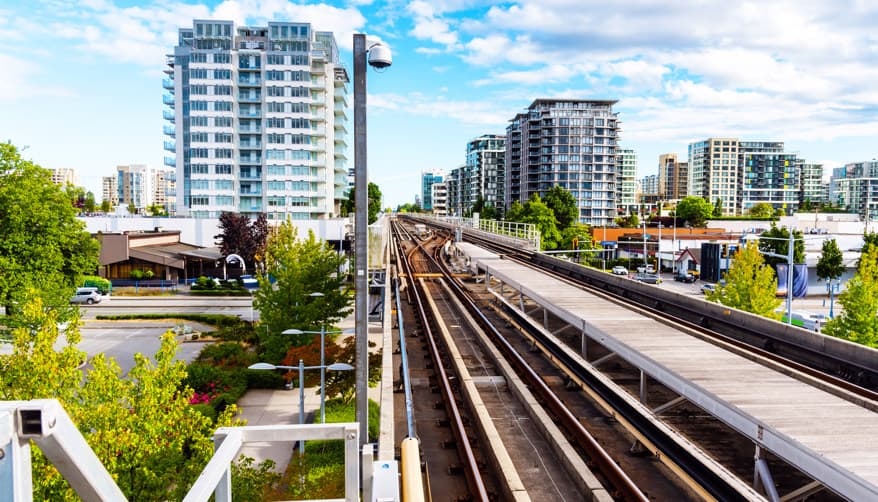
California Senate Bill 79, the Abundant and Affordable Homes Near Transit Act, introduces a statewide zoning framework that enables mid-rise residential development near major transit stops. The legislation establishes clear, tiered standards for height, density, and floor area ratios, while overriding restrictive local limits within designated transit areas. SB 79 is designed to align housing growth with existing infrastructure, reduce car dependence, and expand supply in high-opportunity neighborhoods. By standardizing entitlements across qualifying corridors, the law provides developers and investors with greater clarity, predictability, and the potential for value creation around transit-oriented locations. This insight report examines the statewide framework created under SB 79 and its implications for entitlement, feasibility, and investment. Featuring Los Angeles as a case study, the report illustrates how local implementation could reshape land use patterns along key Metro corridors, including the B, D, A, E, and K lines. As the policy takes effect in mid-2026, SB 79 is expected to drive renewed interest in infill development, strengthen collaboration between cities and transit agencies, and advance the next generation of sustainable, transit-connected communities across California.